Autofocus Systems Explained
Modern autofocus is an engineering marvel combining advanced optics, specialized sensor hardware, and complex machine learning algorithms.
The Role of Autofocus
Achieving critical focus is essential for sharp, usable imagery. Before the advent of digital systems, focusing was an entirely manual, mechanical process. Today's cameras perform thousands of calculations per second to drive internal lens motors with microscopic precision. The two primary methods by which digital cameras evaluate focus are Contrast Detection and Phase Detection.
Contrast Detection AF (CDAF)
Contrast detection operates on a simple principle: an image is sharpest when the contrast between adjacent pixels is highest. The camera's processor analyzes the pixel data from the main image sensor. If the contrast is low, it commands the lens to adjust focus slightly. It re-evaluates the contrast, and if it increases, it knows it is moving in the right direction.
The primary drawback of CDAF is that the camera does not inherently know which direction to move the lens elements to achieve focus, nor how far to move them. It must "hunt" back and forth past the point of peak sharpness to confirm it has found the maximum contrast. While highly accurate for stationary subjects, this hunting behavior makes CDAF generally unsuitable for fast-moving action or continuous video tracking.
Phase Detection AF (PDAF)
Phase detection solves the directional problem. It works by splitting the incoming light into two separate images and projecting them onto a pair of micro-lenses. If the subject is in focus, the two light beams align perfectly. If it is out of focus, the phase difference between the two beams tells the camera's processor exactly which direction to drive the lens motor and precisely how much distance to cover.
Because PDAF provides immediate directional data, it is incredibly fast and responsive, capable of tracking high-speed subjects without the hunting associated with contrast detection. Historically utilized in DSLRs via a separate autofocus sensor, phase detection has successfully migrated to mirrorless systems via on-sensor PDAF pixels masked across the main imaging plane.
Hybrid AF Systems
Modern mirrorless cameras rarely rely on just one system. They employ Hybrid Autofocus, marrying the raw speed and tracking capability of Phase Detection with the pinpoint final accuracy of Contrast Detection. In a typical hybrid sequence, the PDAF system rapidly drives the lens to the approximate focal plane in milliseconds, and the CDAF system takes over for a micro-adjustment to ensure absolute critical sharpness.
Subject Tracking and Machine Learning
The hardware is only half of the modern autofocus equation; software provides the intelligence. Current camera processors utilize machine learning algorithms trained on massive datasets to recognize specific subjects within the frame.
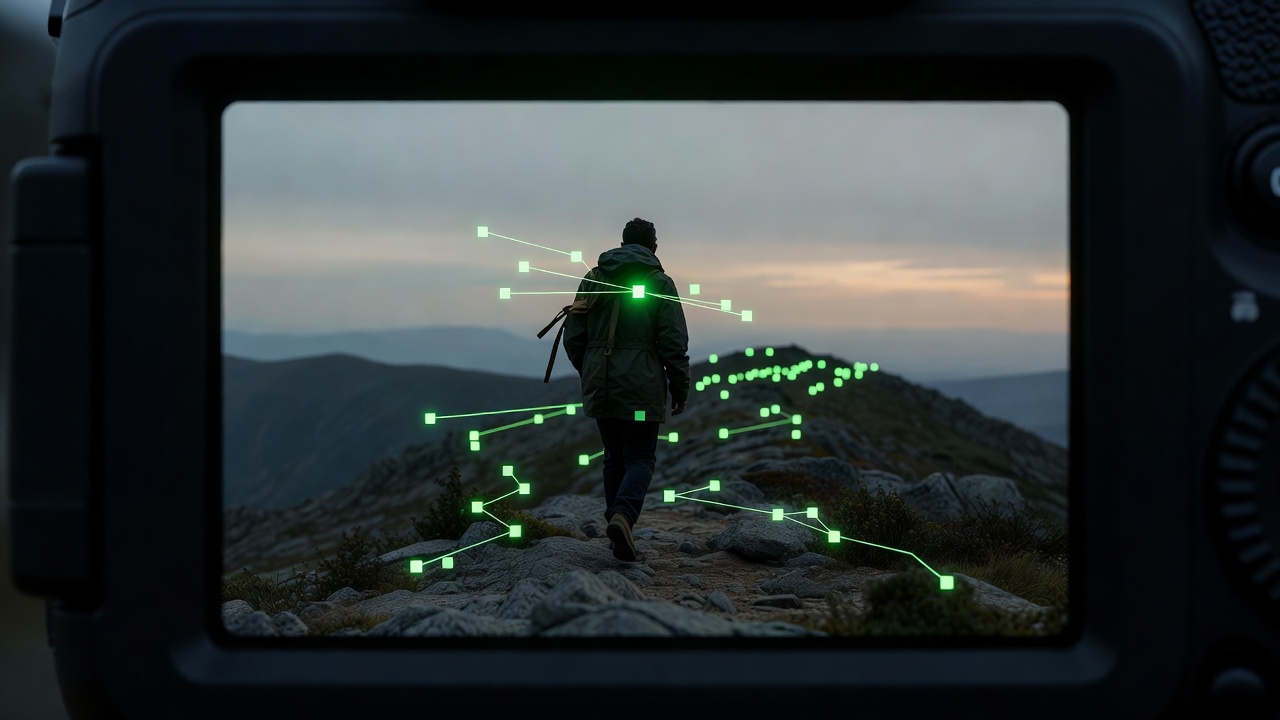
Face and Eye-Detection AF revolutionized portrait and event photography by automatically locking onto human eyes and maintaining focus even as the subject turns or moves erratically. This technology has expanded into animal detection (dogs, cats, birds) and vehicle detection (motorsports, trains, aircraft). By recognizing the subject type, the camera can prioritize the focal plane to keep the most critical elements—like a bird's eye or a driver's helmet—perfectly sharp.
Low Light and Video Considerations
Autofocus performance degrades in low light due to a decreased signal-to-noise ratio. Manufacturers specify a camera's AF sensitivity in Exposure Values (EV). An AF system rated to -4 EV or -6 EV can lock focus in near darkness. Fast aperture lenses assist significantly here by letting more light reach the phase-detection pixels.
In video production, autofocus requirements change. Snappy, instantaneous focus is jarring to the viewer. Videographers rely on smooth, cinematic focus transitions. Modern algorithms allow users to customize the AF transition speed and subject-shift sensitivity, ensuring the camera mimics the smooth pulls of a professional focus puller.
Conclusion
Understanding whether your camera uses CDAF, PDAF, or a hybrid system dictates how you should approach challenging shooting scenarios. Leveraging modern tracking algorithms allows creators to offload the technical burden of focusing and concentrate entirely on composition, lighting, and narrative.