Mirrorless vs DSLR Architecture
For decades, the DSLR dominated professional imaging. Today, mirrorless architecture represents the standard. Understanding the physical differences between these systems is crucial.
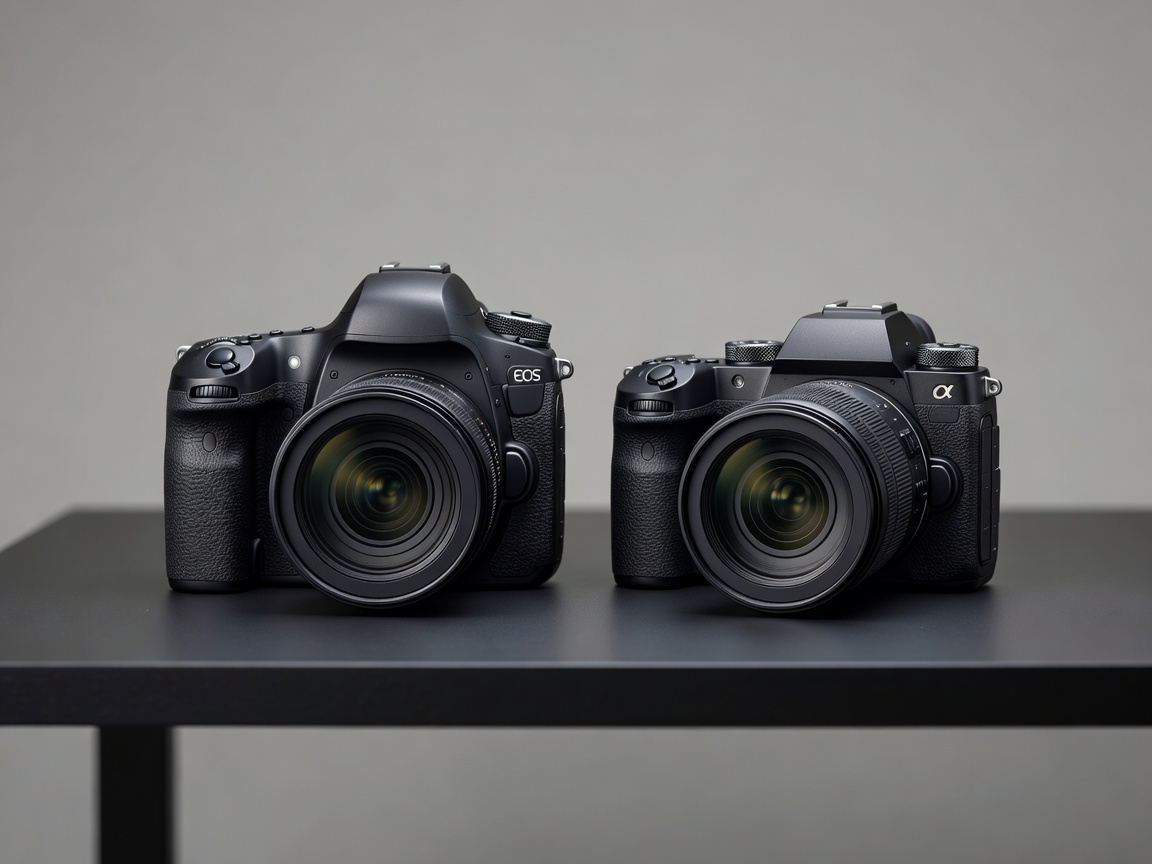
The Core Structural Difference
The defining feature of a Digital Single-Lens Reflex (DSLR) camera is the mirror box mechanism. Light enters the lens and hits a reflex mirror positioned at a 45-degree angle, which bounces the light upward into a pentaprism (or pentamirror), redirecting it out through the optical viewfinder (OVF). When a photograph is taken, the mirror flips up, the mechanical shutter opens, and light strikes the image sensor.
Mirrorless cameras, as the name implies, eliminate this reflex mirror mechanism entirely. Light travels straight through the lens and directly onto the image sensor at all times. This fundamental architectural shift dictates almost every other difference between the two formats, from size to autofocus methodology.
Viewfinder Technologies: OVF vs EVF
Because mirrorless cameras lack an optical path to the eye, they rely on an Electronic Viewfinder (EVF). An EVF is essentially a miniature, high-resolution screen that displays a real-time feed directly from the image sensor. Early EVFs suffered from low resolution and noticeable lag, but modern iterations offer incredibly fast refresh rates, high dynamic range, and imperceptible latency.
The primary advantage of an EVF is "exposure simulation." What you see in the viewfinder represents the final image, reflecting real-time changes to shutter speed, aperture, ISO, and white balance. In contrast, an OVF simply shows the ambient light passing through the lens, which many traditionalists prefer for its zero-lag clarity, especially in studio or highly dynamic sports environments.
Flange Focal Distance
Removing the mirror box reduces the flange focal distance—the distance between the metal lens mount and the image sensor. DSLRs typically require a flange distance of over 40mm to accommodate the swinging mirror. Mirrorless systems have flange distances commonly between 16mm and 20mm.
This shorter distance has profound implications for lens design. It allows optical engineers to place rear lens elements much closer to the sensor, which simplifies the design of wide-angle lenses, reduces overall lens size, and allows for superior edge-to-edge sharpness. Furthermore, the short flange distance makes it incredibly easy to adapt older DSLR and vintage film lenses to mirrorless bodies via simple spacer rings.
Autofocus Paradigms
DSLRs traditionally rely on a dedicated phase-detection autofocus (PDAF) sensor located in the base of the camera, receiving light from a secondary sub-mirror behind the main reflex mirror. This system is exceptionally fast but only works when the mirror is down (using the viewfinder). In live-view mode, DSLRs switch to slower contrast-detection autofocus using the main sensor.
Mirrorless cameras embed phase-detection pixels directly onto the main image sensor. This unified approach means the camera uses the exact same, fast autofocus system regardless of whether you are looking through the EVF or using the rear LCD. It also allows for focus points to cover almost 100% of the frame, whereas DSLR autofocus points are typically clustered near the center.
Size, Weight, and Battery Life
By shedding the mirror mechanism and optical prism, mirrorless camera bodies can be significantly smaller and lighter. However, professional mirrorless lenses can still be quite large and heavy to meet optical demands, meaning the overall system weight reduction is sometimes less than anticipated.
Battery life remains an area where DSLRs hold an advantage. An optical viewfinder requires zero power. Mirrorless cameras constantly power the main image sensor, processing engine, and an EVF or LCD screen just to frame a shot. While mirrorless battery capacities have improved dramatically, a single DSLR battery can often outlast a mirrorless battery by hundreds, or even thousands, of frames.
The Verdict
While DSLRs remain highly capable machines with massive native lens ecosystems and excellent battery life, the industry has universally pivoted toward mirrorless architecture. The benefits of on-sensor phase detection, advanced subject-tracking algorithms, silent electronic shutters, and simplified lens design make mirrorless technology the superior choice for most modern applications.